
History of Computer-aided Architectural Design
1. The design process
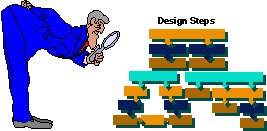
To identify the problem of design in general, and of architectural design in particular, it is necessary first to define the term design. While many definitions and models of design exist, most agree that "design is a process of inventing physical things which display new physical order, organization, form, in response to function" [Alexander, 1964: 6]. However, since no formula or predetermined steps exist which can translate form and function into a new, internally-consistent physical entity, design has been held to be an art rather than a science. It is considered to be an iterative, "trial-and-error" process that relies heavily on knowledge, experience, and intuition.
Intuition became a basis of many design theories, often referred to as "black box" theories. According to them, design, as well as its evaluation, tend to be highly subjective. In contrast, another set of theories define the design process as a problem-solving process. According to the latter, design can be conceived as a systematic, boundedly, rational activity. As defined by researchers like Alexander [1964], Newell and Simon [1972] over the past twenty years, for every problem there exists a solution space, that is, a domain that includes all the possible solutions to a problem. Problem-solving then can be characterized as a process of searching through alternative solutions in this space to discover one or several which meet certain goals and may, therefore, be considered solution states. The way by which the design problem will be solved can be either deterministic or probabilistic.
In the early 1960s, Alexander [1964] published a highly influential book
titled Notes on the Synthesis of Form . In it Alexander quotes the
need for rationality in the design process. If design, he argues, is a conceptual
interaction between form and context, there may be a way to improve it by
making an abstract picture of the problem, which will retain only its abstract
structural features. As a mathematician, he introduced set theory, structural
analysis, and the theory of algorithms as tools for addressing the design
problem. He asserted that even quality issues can be represented by binary
variables. If a misfit occurs, the variable takes the value 1; if not, 0.
Each binary variable stands for one possible kind of misfit between form
and context. This approach was followed by a flurry of related research
into the problem. However, Alexander's contribution was much more far-reaching.
He introduced computers into the design process by suggesting which aspects
of the design process are amenable to systematization and which are not.
Further, he suggested that the design process entails frequent changes of
mind (or changes of constraints, in scientific terms) and that a system
should permit these changes to occur. 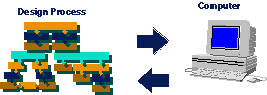
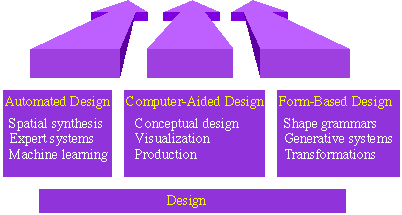
In the next few sections we will try to identify, describe, and evaluate the role of computers in architectural design. Automated design systems are discussed first, with particular emphasis on expert systems and artificial intelligence. Augmented design systems are discussed next; their inherent difficulties are pointed out in an attempt to explain the reasons for their marginal contribution in the architectural design process. Third, a new concept, that of formalistic design, is discussed briefly.
2. Automated Design
2.1. Automated Spatial Synthesis
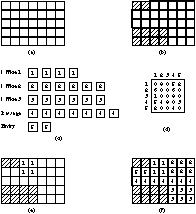
One of the areas where the computer can be helpful to an architect is in space allocation, in finding a large number of possible schemes at a sufficiently early stage of the design process, and choosing the best one for further development. An early attempt was MIT's BUILD system [Dietz, 1974] which could be used to describe spaces that might go into a building, indicating their dimensions, their arrangement, and their materials. The computer then arranged the spaces.
2.2. Machine Learning
Some theorists have argued that many problems cannot be solved algorithmically [Gill, 1978], either because the procedure leading to their solution is ill-defined or because not all the information needed to solve them is available or accurate. Such problems make it necessary to use heuristic and adaptive decision procedures. Heuristic methods typically rely on trial-and-error techniques to arrive at a solution. Such techniques are, by definition, much closer to the search-and-evaluate processes used in architectural design. In adaptive procedures, the computer itself learns by experience, as in Negroponte's "architecture machine" [1970], which could follow a procedure and, at the same time, could "discern and assimilate" conversational idiosyncrasies. This machine, after observing a user's behavior, could reinforce the dialogue by using a predictive model to respond in a manner consistent with personal behavior and idiosyncrasies. The dialogue would be so intimate, "that only mutual persuasion and compromise would bring about ideas." [Negroponte, 1970: 13] The role of the machine would be that of a close and wise friend assisting in the design process.
2.3. Expert Systems
This approach became the basis of relatively recent developments. In systems, known as expert systems , knowledge about a specific area of human expertise is codified as a set of rules. By means of dialogue with the user, the system arrives at a solution to a particular problem. New knowledge is provided by the user to the knowledge base without a programmer having to rewrite or reconfigure the system. The ability of the system to justify conclusions and to explain reasoning, leads to further systematization of the design process, but also, sometimes, to unpredictable behavior by the computer.
3. Computer-Aided Design
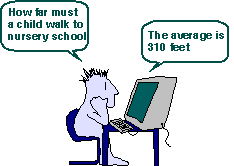
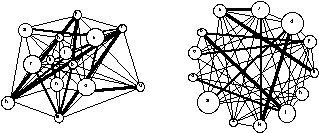
As a result of growing computer capabilities during the 1960s, automated design engendered a great number of expectations. Unfortunately, most of these expectations were not met, perhaps because machine intelligence was overestimated. Architectural design is a much more complicated process than many other processes because it entails factors that cannot be codified or predicted. The heuristic processes that guide the search rely not only on information pertinent to the particular problem, but also on information which is indirectly related to it. In addition, the states that describe the design process do not exist before they are generated. Therefore, a solution state can only be identified "after the fact", that is, after it has been generated.
Design can become too complicated!
3.1. Conceptual design
These problems, as well as the computer needs of architectural offices, led to changes in the approach to Computer Aided Architectural Design (CAAD). Rather than emulating architects, the approach in the 1970s was predicated on the belief that they should be eliminated. The machine was introduced as an aid to instruction, as a mediator for the goals and aspirations of the architects. The computer could communicate with architects by accepting information, manipulating it, and providing useful output. In addition to synthesizing form, computers are also able to accept and process non-geometric information about form. Therefore, it is necessary for architectural design languages to be invented to describe operations on building databases. One pioneering effort in this area is GLIDE [Eastman and Henrion, 1976], a language which allowed the user to assemble buildings.
Another approach in the direction of computer-augmented architectural design, was the manipulation of architectural forms according to rules [Mitchell, 1974]. Basic structural and functional elements were assembled to make volumes (elements of composition) which, in turn, were assembled to make buildings. All elements were stored in the computer's memory in symbolic form, and the user operated on them by manipulating symbols in accordance with rules derived through the classic academic tradition.
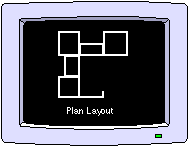
Negroponte's [1974] early vision of machine intelligence, came true with a pioneering system which allowed the user to generate a design solution by employing elements from a standard menu displayed on the screen.
3.2. Visualization
As design began to be increasingly thought of as a systematic and rational activity, many of its empirical and experimental rules were explored. By operating on symbolic structures stored in the computer's memory and manipulating them according to rules, computers could reason about, or even predict, the behavior of a simulated environment. The machines were made to carry out a "make-believe" happening, a simulation.
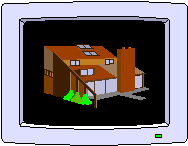
Numerous simulation models were formulated and much progress was made toward simulating design states [Rasdorf and Kutay 1982; Lafue 1979]. These models simulated the states of a designed environment and the transitions from one state to another. Yet, no model was formulated which could encompass both the relationships between the components of a building and its environment.
3.3. Production
4. Form-Based Design
The failure of CAD to improve the architectural design process and products is probably due to the fact that most of the researchers did not consider the idiosyncrasies of architectural design. In architecture, design quality is reflected in forms and their relationships. Many architects and theorists have argued that what distinguishes a well-designed building from one that is poorly designed can only be found in the morphological relations that the former embodies. "One can have a beautiful idea of winning a chess game. One can brutally win a chess game in a very inelegant way. But there can be an elegance in the process of winning itself, that is poetic. We are looking for the poetic in the process, regardless of the result. We are looking for a beauty internal to the idea of the play, that is, when one suddenly gets the shiver." [Ford, 1986: 34]
Formalistic design is viewed as an activity, which entails invention and exploration of new forms and their relations. Various methods of analysis have been employed in the search of new forms: formal analysis involves the investigation of the properties of an architectural subject. Composition, geometrical attributes, and morphological properties obeying Galilean and Newtonian principles are extracted from figural appearances of an object. In contrast, structural analysis, deals with the derivation of the motivations and propensities which are implicit within form and which may be used to define the limit between what it is and all other possibilities. [Brown,1986]
Form-Based Design Directions:
4.1. Shape Grammars
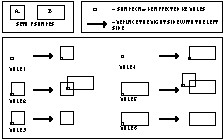
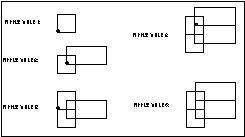
One approach to formalistic design is that of shape grammars [Stiny 1985; Flemming 1986]. They were developed to carry out spatial computations visually and are used to generate designs based on formal rules. A shape grammar consists of rules and an initial shape. There are two types of shape grammars. In standard grammars, each rule is defined explicitly by a pair of shapes separated by an arrow. The shape on the left side of the arrow determines the part of the shape to which the rule is to be applied. The shape on the right side of the arrow determines the shape that results when the rule is employed. In parametric grammars, rules of this kind are defined implicitly by rule schemata. These allow the lengths of lines and the angles between lines to be altered. Shape grammars reveal a lot about languages of design. They have been used extensively for the generation of patterns, diagrams, and floor layouts.
4.2. Generative Systems
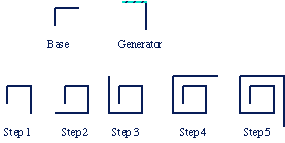
An interesting variation of shape grammars is that of fractal generative systems . Based on a scheme, formulated by the German mathematician Von Koch, a fractal process, consists of an initial shape (the base) and one or more generators. From a practical point of view, the generator is a production rule: each and every line segment of the base is replaced by the shape of the generator. The implementation of an interactive computer program has been reported by Yessios [1987] which allows the fractal to be generated one at a time or at multiple increments, backwards or forwards. As described by Yessios, "a building typically has to respond to a multiplicity of processes, superimposed or interwoven. Therefore, the fractal process has to be guided, to be constrained and to be filtered. The fractal process has to be 'mutated' by the utilitarian requirements of the functionalities of a building." [Yessios, 1987: 7]
4.3. Transformations
Another approach to formalistic design is that of transformations. It involves two important principles of architectural form: stability and change [Eisenman, 1986]. A transformation is not exactly a form-making procedure because the subject of transformation must already be complete. In a transformation only relations change. No new elements can be introduced or removed; bits cannot be added or taken away. However, the illusion of movement, often described as "frozen movement", has been argued to have a high architectonic value. [Evans, 1986] It illustrates the forces designers have referred to, as "punctured volumes," "compressed planes," "interpenetrating spaces," or "agitated surfaces."
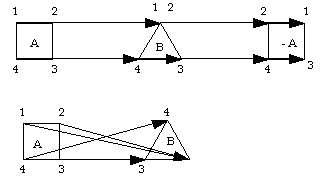
The concept of transformation has not yet been implemented extensively in computer-aided design. One interesting exploration of shape transitions has been reported by Yessios [1987]. According to him an initial shape A can be transformed to a target shape B by applying any number of in-between steps. All the points of shape A are mapped onto shape B and vice-versa. Furthermore, once the rules of transition have been established, the transition can be allowed to continue beyond its target, to infinity.
References