Shape Characteristics 
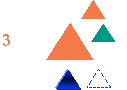
By observing the three black shapes below one can distinguish the existence
of a fourth shape implicitly created. It seems that shape is an abstract
entity that exists inside the mind and does not necessarily have to be
related to some material.

Shape is an abstract entity that possesses certain geometric characteristics.
The implicit triangle (above) is more about a geometry of a three equally
spaced points and can be recognized regardless of the variations in size,
color, line weight, etc.
The study of shapes and their attributes is a part of geometry (= earth
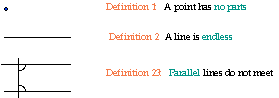
measurement). In Euclidean geometry (350 BC) there are definitions and
rules that describe the behavior of the geometric entities. These entities
are creations of the mind and have no correspondence to the real world.
An infinite line or an infinite plane are thing that can exist only in
the human mind.
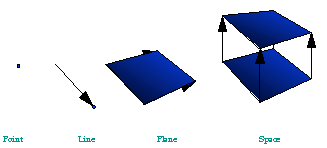
A point creating a line through its movement, a line creating a plane,
and a plane creating space are abstract definitions that allows one to
understand the concepts of time and space.
- Point creates line
- Line creates plane
- Plane creates space
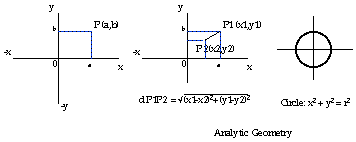
In Cartesian geometry (1637 AD) points are identified by their orthogonal
projections (x,y,z). Shapes are defined as relationships between points,
i.e. a circle is a shape where points raised to the square have a certain
value (r). In other words, analytic geometry defines shapes through the
relationships of points.
Shape definitions:
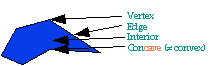
Edges are the sides of a shape. Vertices are the points where edges meet.
Interior are all the points that are enclosed within the edges. Two edges
are concave when the angle they meet is more than 180 degrees (else they
are convex)
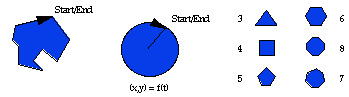
Irregular and regular shapes
Regular shapes are shapes that can be described through a relationship
of points. Until a relationship is found that describes the location of
vertices a shape is refereed to as irregular.
Shape Characteristics
A shape can be characterized and measured by the following relationships:
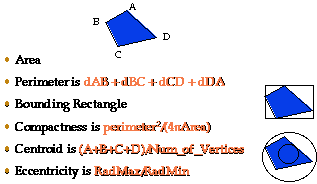
Area is all the points that are enclosed within the edges of a shape.
The number can number of points, pixels, square feet, etc.
The perimeter is the addition of the lengths of all the edges.
Bounding rectangle is a rectangle that fully encloses the
shape.
Compactness is a value that characterizes the degree of how close
to circle the shape is.
Centroid is a point that is calculated by adding all the coordinates
of the edges and dividing it by the number of edges (or vertices).
Eccentricity is the ratio of the circumscribed circle by the inscribed
circle.
Shape Properties
- Balance
- Symmetry
- Axiality
- Proportion
- Rhythm
- Hierarchy
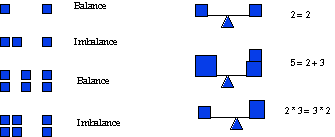
Balance
Balance is the state of distribution in which all action has come to a
standstill. (Arnheim, 1977: 20)
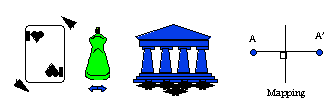
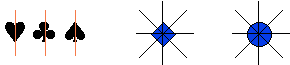
Symmetry
Symmetry is a transformation that leaves the shape invariant
Axiality
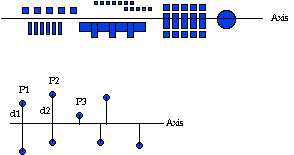
Axiality is the arrangement of elements along a line
Proportion
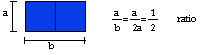
Proportion is the quantitative comparison between things
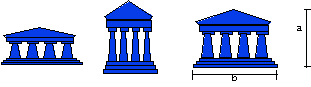
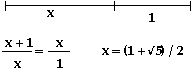
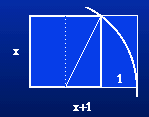
The Golden ratio
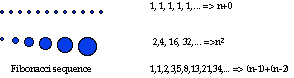
Rhythm
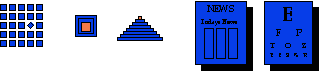
Rhythm is the rate of repetition

Hierarchy
Hierarchy is a scale of power, weight, or importance created visually by
perceptual gradients. (Arnheim, 1982: 217)
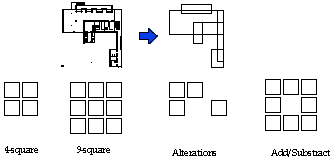
Parti
Parti is an abstraction of a visual composition
Movement and Change
Movements of shapes can be seen by the result.

Liquid Shape
Imagine a shape that constantly changes form

but maintain its four edges and vertices.
As long as it has four sides it is a valid transformation
The study of such transformations is called topology.

The mug and the key are equal "shapes" topologically because
they both have one hole in them. As long as no cutting operation is performed
that would destroy the identity of the hole, the two objects will be pronounced
equal.
Shape Network
A shape can be represented as points and connections
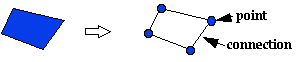
Reversely, a series of points and connections can be represented as a shape
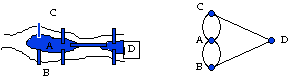
Things to Consider:
- What is the importance of analysis?
- What is abstraction?
- Is mathematics important in Architecture? Why?
References
Arnheim, R. The Dynamics of Architectural Form, University of California
Press, 1977
Devlin, K. Mathematics: The Science of Patterns, New York: Scientific
American Library, 1994
Vakalo, G.-E., Visual Studies, Nefeli, 1978.